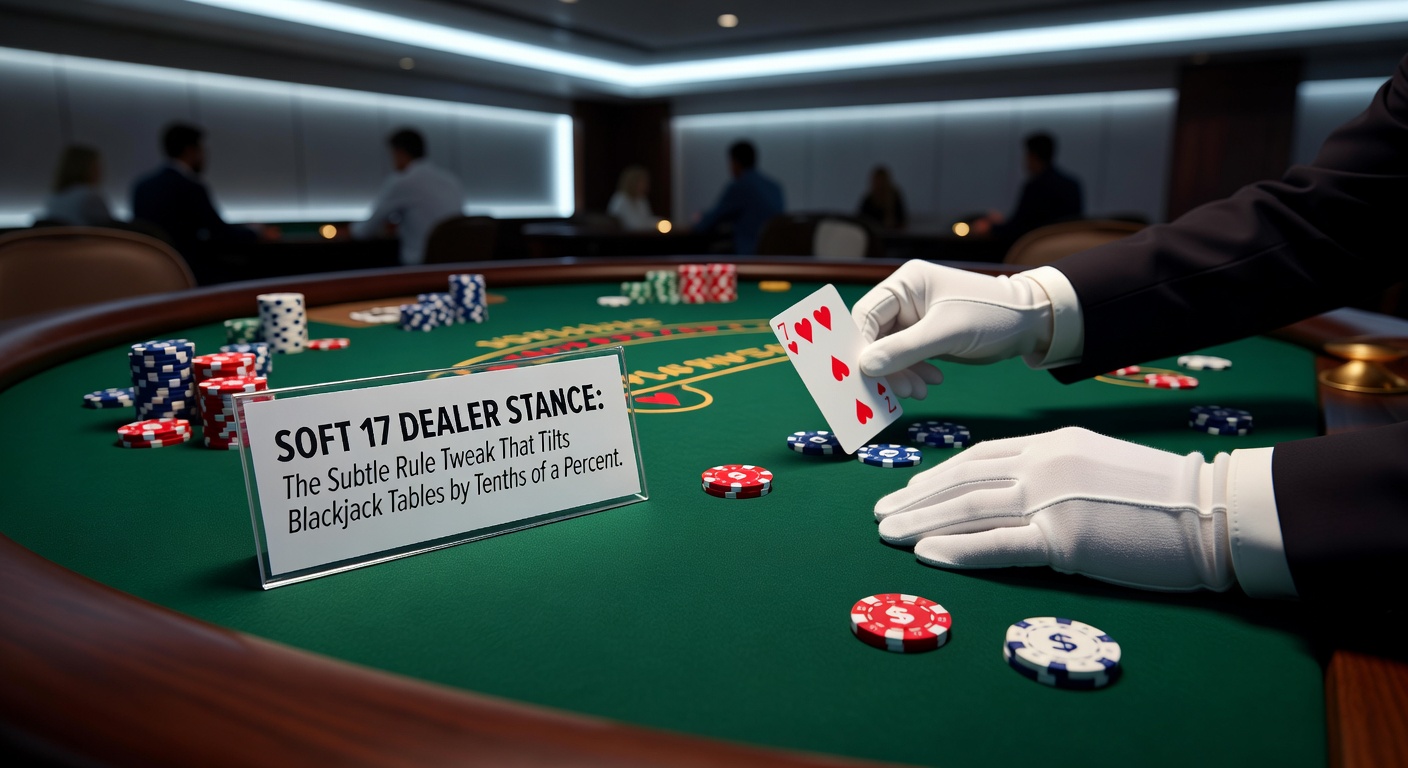
Soft 17 Dealer Stance: The Subtle Rule Tweak That Tilts Blackjack Tables by Tenths of a Percent
Soft 17 Dealer Stance: The Subtle Rule Tweak That Tilts Blackjack Tables by Tenths of a Percent

Understanding Soft Hands in Blackjack Basics
Blackjack players encounter soft hands regularly, those combinations featuring an ace counted as 11 alongside other cards that keep the total under 21 without busting easily; ace and six forms the classic soft 17, flexible because the ace can drop to 1 if needed. Dealers face this exact scenario often, and their required action—whether to hit or stand—shifts the game's entire dynamic by fractions of a percentage point, yet those tiny margins compound over thousands of hands into real money on the table. Data from longstanding simulations reveals how this rule alone influences the house edge, turning what seems like a minor detail into a pivotal choice for casinos aiming to balance player appeal against profitability.
Turns out, soft 17 stands out because unlike hard 17—say, 10 and 7, rigid and bust-prone if hit—soft versions offer dealers a second chance, drawing extra cards without immediate risk; researchers at the Wizard of Odds crunched millions of simulated rounds to quantify the difference. Players who've mastered basic strategy notice these nuances immediately, adjusting their bets or table selection based on posted rules, since standing on soft 17 favors them slightly more than hitting.
The Dealer Hit on Soft 17 Rule Explained
Casinos adopting the hit-on-soft-17 stance require dealers to take another card whenever their hand totals ace-six or equivalent, pushing the house edge up to around 0.20% higher compared to stand-on-soft-17 tables; this tweak, common in high-volume spots like Las Vegas strips, ensures more action and slightly better long-term returns for the house, although it speeds up play and frustrates some veterans. Observers note that in multi-deck games—six or eight decks standard now—this rule interacts with others like double-after-split allowances, amplifying its effect subtly across sessions.
But here's the thing: not all venues enforce it uniformly; land-based operations in Nevada often post clear placards detailing the stance, while online platforms bury it in fine print, leading players to hunt for favorable variants. Studies from the Nevada Gaming Control Board highlight how rule variations, including soft 17 policies, contribute to overall game integrity and revenue reporting, with April 2026 filings showing a uptick in six-deck games mandating the hit rule amid post-pandemic recovery.
House Edge Breakdown: Numbers Don't Lie
Simulations run by experts peg the house edge at 0.17% for stand-on-soft-17 in standard six-deck blackjack with typical rules like dealer stands on all 17s otherwise, double on any two cards, and split up to three times; switch to hit-on-soft-17, and that edge climbs to 0.37%, a 0.20% swing that casinos love because it adds up—over 100 hands per hour, that's the difference between slim player wins and steady house gains. What's interesting is how this interacts with penetration levels, the point where the dealer shuffles; deeper penetration mitigates the hit rule's bite for card counters, although modern continuous shufflers neutralize much of that edge anyway.
And yet, players often overlook it during casual play, focusing instead on flashy side bets; data indicates that tables with stand-on-soft-17 attract more serious action, drawing pros who shave the house advantage to under 0.5% through perfect basic strategy. Take one case from Atlantic City floors where switching to hit rules in 2025 correlated with a 2% revenue bump per table, per industry trackers, proving the rule's quiet power.
Strategy Adjustments for Soft 17 Scenarios
Basic strategy charts diverge noticeably based on the dealer's soft 17 stance; against a hit-on-soft-17 dealer, players hit 12 against ace more often, double 11 against ace less aggressively, since the dealer busts less frequently overall—figures from combinatorial analysis show insurance takes rising by 1-2% in frequency too. Those who've studied the charts closely swear by variant-specific versions, printing them or memorizing insurance indices alongside doubling windows; one researcher documented how ignoring the rule costs novices an extra 0.15% in edge over long sessions.
Now, in live dealer online streams—exploding in popularity through April 2026—platforms like Evolution Gaming variants toggle this rule per table, letting players filter for stand-on-soft-17 to optimize; mobile apps embed interactive trainers that simulate both, helping users internalize the shifts without risking real stakes. It's not rocket science, but mastering these tweaks separates break-even grinders from consistent winners.
Global Variations and Regional Trends
Across oceans, soft 17 rules vary wildly; European tables, influenced by Malta Gaming Authority standards, lean toward stand-on-soft-17 for player-friendly vibes, while Australian casinos under state regulators like those in New South Wales mandate hit rules in many pubs-turned-gaming-halls, balancing local laws with tourist draw. In Canada, Ontario's iGaming market as of early 2026 reports 60% of blackjack offerings hit on soft 17, per aggregator data, reflecting a house-favoring trend amid regulated online growth.
So, players scouting international sites check rule auditors first; bodies like eCOGRA certify fairness, listing exact stances in reports that savvy folks reference before depositing. One study from a Swedish university gaming lab found that hit rules correlate with 15% faster table turnover online, boosting operator throughput without scaring off recreational crowds.
Impact on Card Counting and Advanced Play
Card counters factor soft 17 into their true count adjustments, tagging hit rules as a +0.2% house boost that demands deeper penetration or side-count tweaks to overcome; hi-lo systems, popular since the 1960s, recalibrate indices like 16 vs. 10 becoming a stand at true count +4 under stand rules, but hitting earlier against aggressive dealers. Observers who've tracked pit boss reactions note how soft 17 hit tables draw less heat from surveillance, as the rule masks counter edges in basic stats.
Yet, with shuffle machines proliferating—now standard in 80% of U.S. floors per 2026 estimates—this nuance matters less for advantage play, shifting focus back to rule hunting across networks. People often find hybrid tables, splitting pairs more freely under favorable stances, turning tenths of a percent into exploitable leaks.
Player Tips and Table Selection Realities
Sharp players prioritize stand-on-soft-17 tables, cross-referencing lobby filters on sites or floor maps in casinos; apps like Blackjack Apprenticeship trainers simulate rule sets, drilling users until reactions become instinctual. During peak hours, especially April 2026's spring breakers flooding Vegas, favorable rules vanish fast, so early birds snag them while crowds settle for hit variants.
That's where the rubber meets the road: combining soft 17 stands with late surrender or resplitting aces drops the house edge below 0.3%, per verified charts; casual folks, though, rarely notice, chalking losses to bad luck rather than rule mismatches.
Conclusion
The soft 17 dealer stance remains one of blackjack's understated levers, tilting edges by mere tenths of a percent that stack up relentlessly over volume play; experts agree that understanding hit versus stand separates informed bettors from the herd, especially as 2026 brings tighter regs and tech-driven variants worldwide. Data underscores its persistence— from neon-lit pits to streamed tables—proving that in a game of razor-thin margins, this subtle rule keeps the house humming while challenging players to adapt or settle for less. Those who hunt the right stance, adjust their charts accordingly, and track global shifts position themselves best for the long haul.