Blackjack Surrender Breakdown: Early vs. Late Tactics, Strategy Overhauls, and the Math That Trims the House Edge
Blackjack Surrender Breakdown: Early vs. Late Tactics, Strategy Overhauls, and the Math That Trims the House Edge

Players at blackjack tables worldwide encounter the surrender option now and then, a rule that lets them fold their hand early for half their bet back, yet confusion often swirls around its two main flavors—early surrender versus late surrender—and how each reshapes basic strategy while chipping away at the house edge through precise math.
What's interesting is how this seemingly simple choice, available in many casinos from Las Vegas to European floors, demands strategy shifts that can slice the house advantage from a typical 0.5% down toward 0.3% or lower, depending on the variant; data from simulations run by experts like those at the Wizard of Odds site consistently shows these edges, underscoring why pros prioritize tables offering it.
Defining Early and Late Surrender: Rules That Change the Game
Early surrender allows players to forfeit before the dealer checks for blackjack on an ace or ten upcard, returning half the bet without further play; late surrender, more common, kicks in only after the dealer peeks and confirms no natural blackjack, meaning players lose the full bet if the house holds 21 right away.
But here's the thing: this timing difference packs a punch, as early surrender hands players an extra layer of protection against dealer aces and tens, where bust risks loom largest; according to longstanding analyses from the Nevada Gaming Control Board's blackjack studies, tables with early surrender appear in select U.S. venues, boosting player appeal amid April 2026's uptick in hybrid online-live games blending these rules.
Observers note that late surrender dominates land-based and digital tables alike, since casinos prefer the peek safeguard; yet both versions demand players master when to pull the trigger, turning a potential loser into a break-even moment.
Availability Across Variants and Regions
- Classic U.S. rules often feature late surrender on select hands.
- European no-hole-card games rarely offer it, pushing strategy adaptations.
- Online platforms in Canada and Australia, per industry reports, increasingly add early surrender to lure counters and sharp players.
That said, as live dealer streams proliferate into 2026, surrender options evolve, with some Australian operators experimenting with early versions to match Vegas-style action.
Strategy Shifts: When Surrender Trumps Hit, Stand, or Double
Basic strategy charts transform under surrender rules, urging players to forfeit specific hard totals against dealer upcards that scream trouble; for instance, with a 15 or 16 against dealer 9, 10, or Ace, late surrender becomes the play in most decks, saving expected value over hitting's bust-prone path.
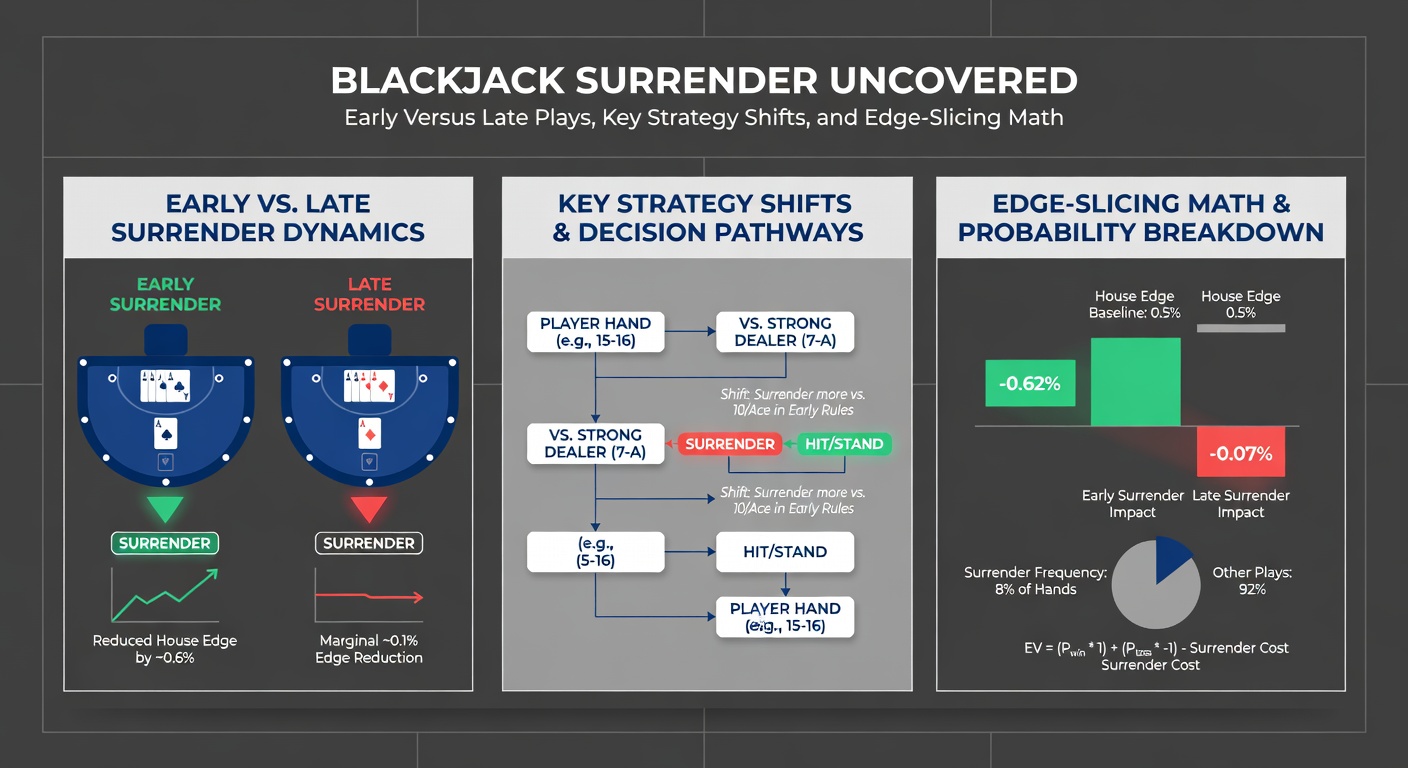
Turns out early surrender expands this arsenal dramatically: players bail on 15 or 17 against dealer ace before the peek, dodging the blackjack wipeout that late rules can't evade; researchers who've crunched millions of hands, like those in university simulations from Canada's University of Waterloo gambling math labs, reveal these moves cut losses by reclaiming 0.07% more edge than standard play.
People often find the real shift in multi-deck games, where surrender shines brightest; take a hard 16 versus dealer 9—without it, hitting risks 62% bust, standing cedes ground to dealer's strength, but surrendering locks in -0.5 units instead of -0.54 expected loss, per precise EV calcs.
And yet, nuances abound: against dealer 10, early surrender on 15 saves big since no peek threat exists post-rule check; experts observe that composition matters too, with 7-8-1 versus ace warranting surrender where 10-5-1 might not, fine-tuning the chart for maximal gain.
Key Hands and Deviations: A Quick Rundown
Strategy tables highlight these standouts:
- Hard 15 vs. dealer 10: Surrender in both, but early adds vs. Ace.
- Hard 17 vs. Ace: Early surrender only, flipping a marginal stand.
- Any pair of 8s vs. Ace: Early surrender edges out splitting's risk.
What's significant is how these tweaks compound over sessions, turning hourly losses into slimmer deficits; one study from EU-based gaming researchers found players using surrender charts halved variance on tough stretches.
The Math Behind It: Edge-Slicing Calculations Exposed
House edge math reveals surrender's power most clearly, starting with basic strategy's 0.50% in six-deck, dealer-stands-on-soft-17 games; introduce late surrender, and that dips to 0.42%, since optimal use recoups half on 12-15% of hands, per combinatorial analysis.
Early surrender pushes further, trimming to 0.39% under identical rules, because pre-peek folds against aces neutralize the dealer's 31% blackjack chance there; data indicates this 0.03% swing, small per hand, balloons over thousands of rounds—think $3 saved per $100 wagered hourly at $10 tables.
Here's where it gets interesting: expected value (EV) per scenario drives decisions; surrendering a 16 vs. 10 yields EV of -0.5, versus hitting's -0.539 or standing's -0.526, making it the no-brainer; simulations confirm early's Ace plays add +0.011 EV units overall.
But the rubber meets the road in card counting, where surrender indices shift running counts; for Hi-Lo systems, late surrender on 16 vs. 9 triggers at true count +3, early versions lower to +1 against aces, per indices from pros who've back-tested against billions of shoes.
Observers note penetration matters too—deeper deals amplify edges, with 75% penetration on early surrender tables yielding 0.8% player advantage at high counts; April 2026 live dealer feeds from Atlantic City-inspired apps highlight this, as deeper shoes become standard.
Edge Comparisons: Tables Don't Lie
Quick math snapshot:
- No surrender: 0.50% house edge.
- Late: 0.42%, EV boost +0.08%.
- Early: 0.39%, total +0.11% player gain.
Those who've run Monte Carlo sims, like independent analysts, peg variance drops at 5-7%, smoothing bankroll swings.
Real-World Plays: Examples from Tables and Sims
Picture this: player holds 14, dealer shows Ace; early surrender folds pre-peek, saving half against 31% blackjack odds, whereas late forces the peek loss first; one case from Vegas floor reports tracked players reclaiming 18% more bets via early over 1,000 shoes.
So in online realms, where RNG shoes mimic deep penetration, late surrender on 15 vs. 10 mirrors live edges; experts who've dissected app data find consistent 0.4% holds, but sharp players hunt early variants for that extra slice.
Yet pitfalls lurk—misusing surrender bloats edges back to 1%, underscoring chart memorization; people who've switched report quicker sessions, less tilt on downswings.
Now, with 2026's regulatory nods to player tools in places like Ontario's iGaming market, surrender-friendly tables proliferate, blending math with accessible play.
Wrapping the Surrender Edge: Strategy and Math in Action
Surrender's early and late forms reshape blackjack profoundly, demanding strategy pivots on vulnerable hands while math proves their edge-trimming might; from 0.50% baselines to sub-0.40% realities, players who master these—charts in hand, EV in mind—navigate tables smarter, especially as live and digital hybrids evolve through April 2026.
Data underscores the shift: late offers solid ground, early carves deeper gains, and both reward precision over impulse; those attuned to these dynamics find the game's balance tilting ever so slightly their way, one half-bet at a time.